If you use AI to write marketing copy, the first worry isn't whether the copy is moving enough. It's this: Will it invent features the product doesn't have? Will it drop the product's usage limits? Can it write genuinely different copy for the website, social and email? And once it's revised, can you ship it?
If those problems aren't solved, AI won't save you time. You'll spend more of it checking and redoing the work.
The short answer: compared with the specialist AI writing tools we tested, ChatGPT — the general assistant your team may already pay for — was the most reliable on facts, and rarely made anything up even when the brief was thin. It was not more reliable than Jasper at delivery, though: of its 6 revisions, 4 were ready to ship, a tie with Jasper. Its weak spot is sentences explaining the source material that end up in the copy (9 of the 18 pieces ChatGPT wrote; we count these as leaked internal notes), and on sparse briefs it often ran short. Read every piece yourself before it goes out.
Enough already? For teams already paying for ChatGPT, here is what this test shows: if factual accuracy is what you care about most, it's enough — no need to buy a specialist writing tool for that. If your priority is copy that meets format and length specs, WRITER (all 12 first drafts met the format spec) and Jasper (11) did better. Whichever you use, have a person review everything before it goes out.
This is the results chart at the top of this page ↑
How we tested
We — analyst.ai, the buyer's lab for AI software — gave ChatGPT, Jasper, Copy.ai and WRITER the same product brief and asked each to write a product page, a social post and a marketing email, then to revise them as instructed. The briefs covered two brands: a water bottle (Owala FreeSip) and a restaurant (Chef Chu’s).
Each tool worked under three conditions: one set from a full brief, one set revised to instructions, and one set from a sparse brief reduced to a single descriptive line. In total, the four tools wrote 72 pieces. The prompt also told the tools to append an internal evidence table and gap notes to every piece, to work a specified limit line into the copy verbatim, to ignore an outdated decoy brief mixed into the materials, and not to browse the web; both kinds of "leaked internal notes" discussed below trace back to these instructions. This is the first batch of a planned 6 brands, tested 2 rounds each.
We didn't judge whose sentences were prettier. We looked at the results through four questions:
- Is it accurate?
- Did it do everything the brief asked?
- Does it write differently for each channel?
- After revision, is it ready to ship?
Each tool ran once under each condition, so a change in one or two pieces moves the percentages. Read the figures for direction, not for decimal points.
Accuracy: does the copy stick to the brief?
This is the first layer, and the most important. Once an unsupported selling point goes out, readers can't tell whether the AI wrote it or the brand said it.
We checked sentence by sentence:
- whether it invented features that aren't in the brief;
- whether it dropped a product limit;
- whether it put words in the customer's mouth;
- whether internal notes ended up in customer emails.
The biggest gap showed up with sparse briefs. We gave only the brand name, one line of description and the call to action (CTA), and watched whether the tools would fill in the blanks. Across each tool's 6 pieces, claims the brief gave no support for: WRITER 15, Jasper 6, ChatGPT 0. Copy.ai's count for these two brands is being re-verified and will be added in a dated update. Pieces out of 6 with no unsupported claims at all: ChatGPT 6, Copy.ai and Jasper 1 each, WRITER 0.
Marketing copy · accuracy
On sparse briefs, ChatGPT added no unsupported claims; WRITER added 15
One square per claim the brief gave no support for, across each tool’s 6 sparse-brief pieces. Fewer is better.
- A claim repeated within one piece counts once. Example: WRITER wrote “durable” and “reusable”; the brief said only that it is an insulated bottle.
- Tools are listed alphabetically, not ranked.
- BEST marks the best result; ties are marked equally.
The Owala sparse brief said only that it is an insulated stainless-steel water bottle. WRITER called it "durable" and "reusable" and compared its insulation time with ordinary bottles. The Chef Chu’s sparse brief gave only the restaurant category and location; Copy.ai still wrote about dining in, and Jasper about picking up food after work. Dine-in and takeout were in the full brief but not in this round, so they were off-limits; WRITER's "durable" and "reusable" appear in no version of the brief at all. What to check before you publish: when the brief is a single line, every adjective and every service in the copy should trace back to that line.
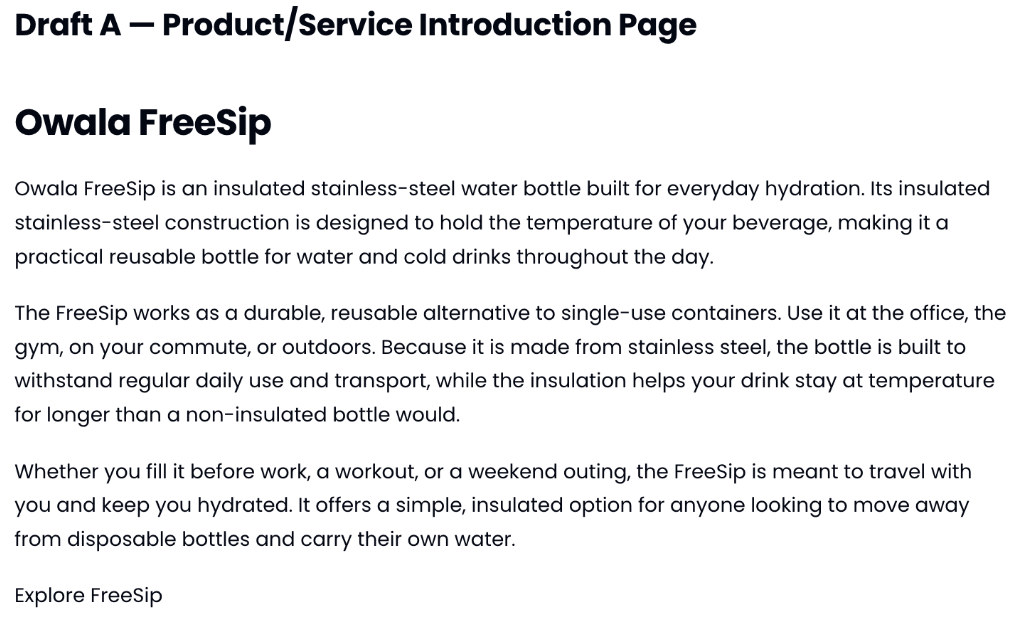
With a full brief, accuracy improved across the board. Pieces out of 6 in which every fact was supported and no key point or limit was left out: ChatGPT and Copy.ai 6 each, Jasper and WRITER 2 each. The problems were subtler, usually hiding in the sentence that reads most like an ad.
Marketing copy · accuracy
Sentences that read smoothly but can’t ship
Full brief. Left: what the brief said; right: what the AI wrote, verbatim.
| Tool · piece | What the brief said | What the AI wrote | Problem |
|---|---|---|---|
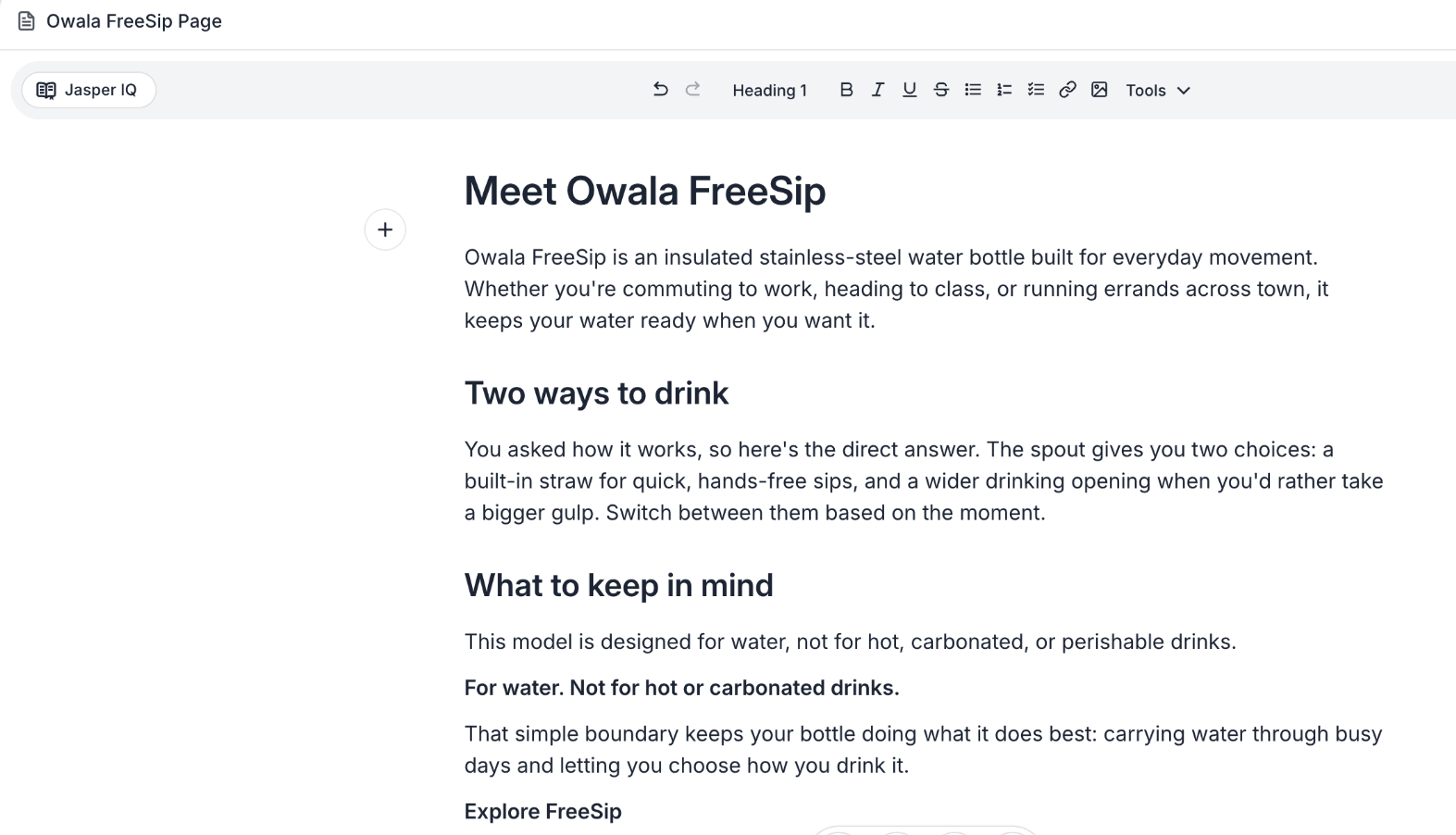
| JasperOwala product page | Built-in straw, wider spout | “a built-in straw for quick, hands-free sips” | Unsupported feature |
| JasperOwala product page | No reader asked anything | “You asked how it works” | Invented question |
| Jasper / WRITERMarketing emails | Bulk send to subscribers | “You asked: can you dine in…” / “You asked whether this model…” | Invented question |
| WRITERChef Chu’s page, email | Dine in or take out | “The same menu supports either choice / option” | Unsupported claim |
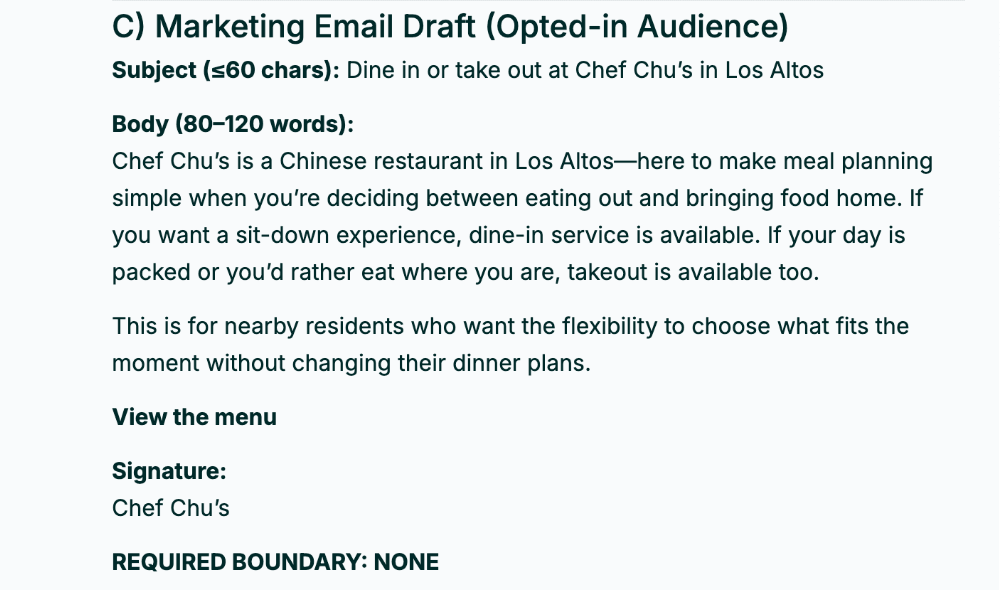
| Copy.aiChef Chu’s email | No such line | “REQUIRED BOUNDARY: NONE” | Leaked internal note |
- ChatGPT’s 6 full-brief pieces had no factual problems, but its Chef Chu’s email has one source-explaining sentence, counted as a leaked internal note.
- Some of these claims may be true in real life; this review judges only against the brief supplied. Highlights are ours.
A built-in straw became "hands-free." Owala's brief mentioned only a built-in straw and a wider spout. Jasper's product page turned that into "a built-in straw for quick, hands-free sips." It reads well, but nothing in the brief says you can drink hands-free. What to check: when the brief names a part, has the copy turned it into a feature?
Customer questions nobody asked. The same product page says "You asked how it works." Jasper's Chef Chu’s email says "You asked: can you dine in, get takeout, or both?" and WRITER's Owala email says "You asked whether this model can hold hot drinks." The last two are bulk emails and the first is a public product page; no reader actually asked any of these questions. One caveat: the prompt asked the tools to address a common buyer question, and counting this phrasing as an unsupported claim is a judgment rule we applied in this review. Relax that rule and Jasper's Chef Chu’s first-draft set would pass. What to check: for every "You asked" line, did a reader really ask?
Internal notes left in a customer email. Copy.ai's Chef Chu’s email still carries "REQUIRED BOUNDARY: NONE" below the signature. That's a task field meant for the tool, not something a customer should see. Across Copy.ai's 12 full-brief drafts and revisions, every one printed this label. Like ChatGPT's source-explaining sentences discussed below, it traces back to the prompt's instructions to append an internal evidence table and write in the limit line. Either way, the copy has to be cleaned up before it can go out, so we count both as leaked internal notes. Before sending, check the last few lines below the signature.
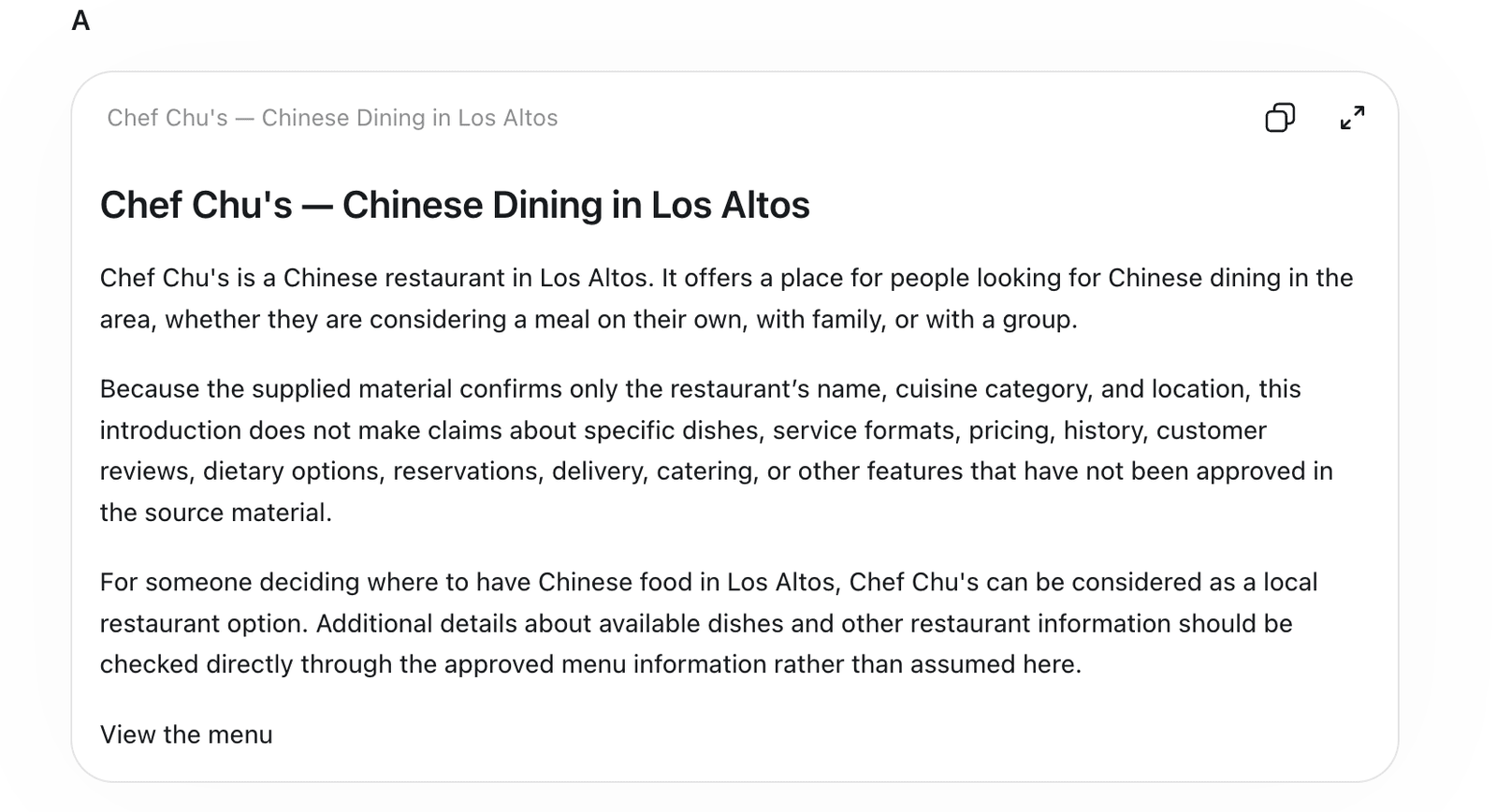
ChatGPT was the steadiest on this test, but it also produced sentences that have to go. In the body copy it explains what the material confirms, and therefore what it will leave out. These sentences don't invent facts, but like Copy.ai's "REQUIRED BOUNDARY," they carry internal notes into public copy, so we count them as failures too: they appear in 9 of ChatGPT's 18 pieces (6 sparse-brief pieces, 1 full-brief Chef Chu’s email and 2 revisions). Before publishing, search the copy for words like supplied, information and material to find these sentences and cut them.
Completeness: did it do everything the brief asked?
This layer looks at whether the copy left things out, came up short or got broken.
- whether it hit the word count;
- whether product limits were kept;
- whether every required element appeared;
- whether revising broke a requirement that had been met.
The most common problem was length. Product pages had to run 120–180 words, social posts 60–100 and email bodies 80–120. On the sparse brief, ChatGPT's three Owala pieces came in at 106, 56 and 70 words, all short of spec. It didn't make things up; the price was running short. With the full brief, Copy.ai's Owala product page was also only 113 words, below the minimum. On the same denominator (all 18 pieces per tool), pieces that missed the word count: Copy.ai 10, ChatGPT 3, Jasper 1, WRITER 0.
Marketing copy · completeness
Five pieces missed the word count; ChatGPT’s ran short on sparse briefs
Grey band: required range. Dot: actual count. Hollow dot: count before revision.
- On sparse briefs ChatGPT didn’t make things up; the trade-off was copy that came in short. The piece that got shorter in revision is Copy.ai’s Owala email.
- Words are counted by spaces; emails count body text only.
Put the full-brief and sparse-brief first drafts together and you get 12 pieces. Pieces that got the brand name, CTA and word count right and left no internal notes behind (source-explaining sentences included) — what we call "met the format spec": WRITER 12, Jasper 11, ChatGPT 5, Copy.ai 1. If source-explaining sentences aren't counted, ChatGPT's figure is 9. This metric checks format only, not whether selling points and limits are complete: all 12 of WRITER's drafts passed, yet its Owala social post left out the perishable-drinks limit.
Marketing copy · completeness
WRITER’s 12 first drafts all met the format spec; Copy.ai’s 1 did
One square per first draft: brand name, CTA and word count all correct, with no internal notes left in.
Met the specMeets it if source-explaining sentences aren’t countedDid not meet it
- ChatGPT: its three sparse Owala pieces ran short; its three sparse Chef Chu’s pieces and its full-brief email had source-explaining sentences. Jasper: 1 piece ran short. Copy.ai: mostly short copy and the “REQUIRED BOUNDARY” field.
- Format only; selling points and limits are checked separately.
- Tools are listed alphabetically, not ranked.
- BEST marks the best result on each measure; ties are marked equally.
Dropping a single limit means rework, too. Owala's brief states that the bottle is not for hot, carbonated or perishable drinks. Jasper's and WRITER's social posts kept hot and carbonated drinks but dropped perishables. A reader who sees that line may assume the limits are complete. Before publishing, check each limit in the brief one by one; don't just confirm that the limit line is there.
Marketing copy · completeness
Jasper and WRITER left out the perishable-drinks limit
Owala social post. The brief lists three limits; squares in order: hot, carbonated, perishable drinks.
IncludedMissing
- Jasper and WRITER both printed the limit line “For water. Not for hot or carbonated drinks.” verbatim, but that line leaves out perishable drinks, which had to be added separately.
- Tools are listed alphabetically, not ranked.
- BEST marks the best result on each measure; ties are marked equally.
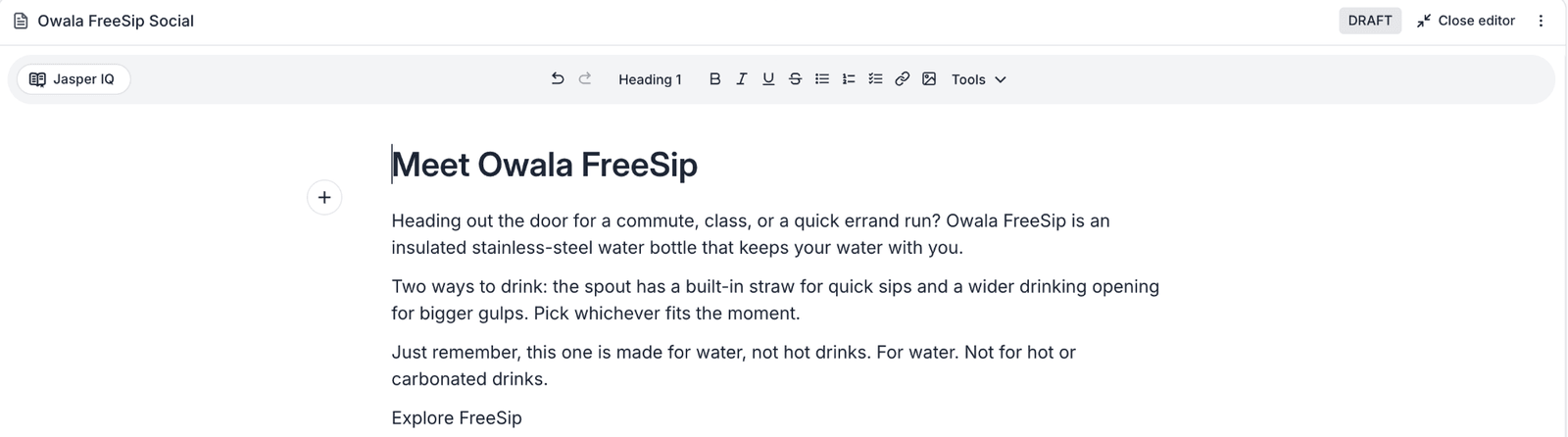
Revising can also undo a requirement. Copy.ai cut its Owala email body from 85 words to 76: an email that met spec before the revision no longer did after it. After any revision, count the words again.
Channels: does each channel get its own copy?
The same brief had to become a website product page, a social post and a marketing email. The three should say the same thing, but each with the emphasis and style of its channel, not the same paragraph reformatted. We looked at:
- whether it fits the specified channel;
- whether the content really differs;
- whether only the opening changed while the body is largely repeated;
- whether the core brand and product information survives;
- whether the set reads like pieces you could use separately.
On core information, the four tools were close. We checked whether all three pieces got the brand name, what the product is, the main selling points, usage limits and the CTA right — 10 items across the two brands. ChatGPT and Copy.ai got all 10 right; Jasper and WRITER missed 1 each (the Owala social post dropped perishable drinks).
The difference was repetition. WRITER's 12 first drafts all met the format spec in the completeness test, but of its 6 full-brief pieces, 2 overlapped by more than half with the other two in their set (the Owala social post at about 65%, the email at about 56%). ChatGPT, Jasper and Copy.ai had none. The 56% piece sits close to the 50% threshold; a small change to the threshold could change the count.
Marketing copy · channels
Only WRITER had pieces that mostly repeated the other two
Each dot is one full-brief piece: its overlap with the other two pieces in its set (shared five-word sequences). Filled dots are above 50%.
- WRITER’s two pieces above half are at about 65% and 56%; the second is close to the threshold. Overlap includes the CTA and limit line every piece must carry, so it flags pieces that need rewriting, not which is better written.
- Tools are listed alphabetically, not ranked.
- Fewer is better: BEST marks the fewest; ties are marked equally.
Passing on format doesn't mean every piece is worth using on its own. Note that the overlap figure includes the CTA and limit line that every piece had to carry. It can flag which drafts need rewriting; it can't tell you which one is better written.
We also didn't use a full brand guide this time, so we can only judge whether the copy fits the brand brief and the task — not which tool understands the brand best or keeps the most consistent voice.
Revisions: is the revised copy ready to ship?
The revision task asked for the CTA to be swapped in all three pieces and a specified first line to be put in. For Owala, "Explore FreeSip" had to become "See the two ways to drink," while the product information, limits and word counts stayed in force. We looked at:
- whether the requested change was made;
- whether the revision still met the word-count, fact and format requirements;
- whether fixing one thing broke another.
All four tools made the required swaps. The difference came after: of 6 revisions, the number ready to ship as is was ChatGPT 4, Jasper 4, WRITER 2, Copy.ai 0. Revised correctly without breaking the original: Jasper and WRITER 6, ChatGPT and Copy.ai 5. Looking at whole sets, those in which all three revised pieces passed: ChatGPT and Jasper 1 each (2 in total), WRITER and Copy.ai 0.
Marketing copy · revisions
ChatGPT and Jasper: 4 of 6 revisions ready to ship
One square per revision.
Ready to ship as isNothing broken, but not ready to shipBroken by the revision
- Most of the gap: original problems carried into revisions. ChatGPT’s Chef Chu’s page revision added a new source-explaining sentence, counted as broken.
- Whole sets passing: ChatGPT 1/2, Copy.ai 0/2, Jasper 1/2, WRITER 0/2.
- Tools are listed alphabetically, not ranked.
- BEST marks the best result on each measure; ties are marked equally.
Most of the gap came from problems in the original drafts carried straight into the revisions. Jasper's Owala product page still says "hands-free." WRITER's Chef Chu’s product page and email still say "The same menu supports either choice / option," while the brief says only that dine-in and takeout are available, not that the menu is the same. Copy.ai's three Chef Chu’s pieces still carry the internal field. Most tools changed only the two lines they were asked to change and didn't fix the other errors along the way; ChatGPT's Chef Chu’s email revision kept its source-explaining sentence, and its product-page revision added a new one. So when you review a revision, don't stop at the two requested lines; go back through the original draft's problems one by one.
Marketing copy · revisions
Where the original problems went
Only the CTA and first line had to change; each row follows one original problem into the revision.
| Tool · piece | Problem in the original | After revision |
|---|---|---|
| JasperOwala product page | “hands-free sips” has no support in the brief | Still there |
| WRITERChef Chu’s page, email | “The same menu supports either choice / option” | Still there |
| Copy.aiChef Chu’s, all three | “REQUIRED BOUNDARY: NONE” left in | Still there |
| JasperChef Chu’s email | Invented “You asked” question | Removed; revision passes |
| ChatGPTChef Chu’s email | “the supplied information confirms that both service options are available” | Still there |
| ChatGPTChef Chu’s product page | No source-explaining sentence in the original | Added “the available information confirms both”; broken |
- Most tools changed only the two lines they were asked to change and didn’t fix the other errors along the way.
It cut the other way, too. Jasper removed the original "You asked" from its Chef Chu’s email, and the revision passed. ChatGPT's Chef Chu’s product-page revision, by contrast, added a line that wasn't in the original — "the available information confirms both" — and failed after revision.
What this review did not measure
We didn't test open rates, click-through, conversions or sales after real publication; we didn't record what each tool costs or how long it takes to generate; and we didn't compare which tool writes more persuasively or understands the brand better. So this review can answer "Is it accurate, is it complete, can it ship?" — not "Which tool sells best?"
Which should you choose?
- If your biggest fear is AI getting product facts wrong, ChatGPT was the steadiest on facts in this test: on sparse briefs it wrote no unsupported claims. But only 4 of its 6 revisions were ready to ship, a tie with Jasper, and source-explaining sentences showed up in 9 of its 18 pieces, which we count as failures. Cut those sentences and check word counts separately.
- If you care most about delivering to spec, the other tools have an edge in places. All 12 of WRITER's first drafts met the brand-name, CTA and word-count requirements, and 11 of Jasper's did; in revision, both completed the changes without introducing new problems. Check closely for selling points beyond the brief and for repeated content.
- If you value accuracy and channel differentiation with a full brief, Copy.ai has strengths too: all 6 of its full-brief pieces had supported facts (tied with ChatGPT), its three pieces got all 10 core-information items right, and its three channels had no large repeated passages. But it had the most word-count misses and leaked labels, and none of its 6 revisions was ready to ship.
- If you want one-click copy with no review at all, no tool in this review met that bar. All four needed manual fixes in at least one type of task.
- If you want to know which tool drives the most conversions, this review can't answer that yet.
In practice, start with a brief you know well: have the tool write all three pieces, then ask for one revision. Read the revision against the original brief, confirming sentence by sentence what's supported and where you need more material. That's closer to everyday review than judging whether the first draft reads smoothly.
For whoever approves the subscription: this comparison covers two brands, with one run per condition. If your team already pays for ChatGPT, these results don't justify adding a specialist writing-tool subscription just to get accurate copy. WRITER's and Jasper's strengths are delivering to spec and revising without breaking things, which makes them worth a trial on your own briefs; none of Copy.ai's 6 revisions was ready to ship. Whichever you choose, budget time for your team to check copy against the brief sentence by sentence.
The tool worth paying for is the one that cuts down on review and rework, not the one that writes fastest.
Scope, limits and disclosures
This review tested two brands once each, the first batch of a planned 6 brands tested 2 rounds each. The test briefs were frozen on September 7, 2026, and the tools were tested on different dates: the three specialist tools around September 8–9; ChatGPT, a general-purpose reference added later and not on the original run list, on September 24. ChatGPT's full-brief first drafts and revisions for Chef Chu’s were resubmitted on September 26 (the two files received on September 24 contained Owala content), and this review scores the September 26 files. Claude and other general-purpose models were not tested in this round. WRITER was used on its free plan; Copy.ai's record lists GPT-5.2 as the model; some plan and run-setting details are incomplete.
The prompt prohibited web browsing, but ChatGPT's record shows browsing switched on (the screenshots show no sign of searches); browsing settings for the other tools weren't recorded. Jasper returned three versions of one revision at once; under our rules, only the first was scored. ChatGPT's email subject lines were missing from the text record and were restored from the original screenshots before scoring. For sparse-brief sets that produced unsupported claims, the plan was to regenerate once with the missing background filled in (a background-repair run); that was not done in this round.
The supporting sentence was recorded for each verdict. Source-explaining sentences in the body copy (ruling J6), like the "REQUIRED BOUNDARY" label Copy.ai printed (J9), count as carrying internal notes into public copy (recorded in the scoring record as a fail on item G3), and the rule applies to all four tools alike; it was dropped at one point during scoring and reinstated on October 10, 2026. Both kinds of leak trace back to the prompt's instructions to append an internal evidence table and write in the limit line. If source-explaining sentences aren't counted, ChatGPT's format-spec result is 9/12 and its ready-to-ship revisions 6/6. Counting invented reader questions as unsupported claims, as the main text does, corresponds to ruling J1 in the scoring record.
On sparse briefs, unsupported claims are judged under one rule (ruling J4 in the scoring record): claims about services and features that the brief doesn't support count as unsupported; suggested occasions for dining or use don't. So ChatGPT's Chef Chu’s product page, which says "whether they are considering a meal on their own, with family, or with a group," describes a suggested occasion and doesn't count — ChatGPT stays at 0. Copy.ai's "a place to dine in" amounts to saying the restaurant offers dine-in service, so it counts. The rule was written into the method on October 10, 2026; it did not change any existing verdict.
This review received no sponsorship of any kind.
Commercial relationships. analyst.ai has no commercial relationship with any product reviewed here: no sponsorship, paid placement, affiliate links, or vendor-provided accounts or credits.
Corrections. Spot an error? Our corrections log and how to report one: analyst.ai/corrections.
Data. The scoring tables behind this review are available to download from this page. Selected original outputs appear as figures above; the full set of originals will be added to the evidence pack.